
In a high-end bathroom the shower is usually the biggest decision. It is the surface you see most, the one that works hardest, and the one that is hardest to change later. We install three finishes for showers: tadelakt, tile and microcement. Each can make a beautiful, watertight shower. They differ in how they look, what goes behind them, how you look after them and the houses they suit.
The short version
- Tadelakt is a Moroccan lime plaster, polished with a stone and sealed with black olive-oil soap. Seamless, soft and old-world, with no grout lines. It develops a patina and gets better with age.
- Tile is the proven choice, with the widest range of looks, from marble-look porcelain to natural stone and handmade tile. It is defined by its joints.
- Microcement is the modern option: a thin, seamless cement-based system with a sleek, more matte finish. Like tadelakt it can be made waterproof, and its main advantage is that it is easier to maintain.
What goes behind the finish
A shower is only as good as what is under the surface you see, and the finish decides what goes underneath it. We waterproof each one differently:
- Tadelakt: cement board with a liquid waterproofing membrane on top.
- Tile: a Schluter system or GoBoard. Both are made for tiled showers: Schluter’s KERDI is a waterproofing membrane bonded to the wall and tiled over, and GoBoard is a foam backer board that is waterproof itself once its joints and fasteners are sealed.
- Microcement: a moisture-barrier primer under the system and its own sealer on top. We use the Topciment system.
We also build curbless showers, wet rooms and steam showers, and the finish and what goes behind it are chosen for each one. Whatever the finish, the floor has to slope to the drain, every niche and bench has to be waterproofed as carefully as the walls, and the brand matters less than a proper install to the manufacturer’s instructions.
How each one looks
Tile is a grid. Large-format tile reduces the grout lines but never removes them, and many of the best tiled showers make the layout part of the design. In one of our bathrooms we used three different marble-look tiles in a layout drawn by hand before any of it was set.
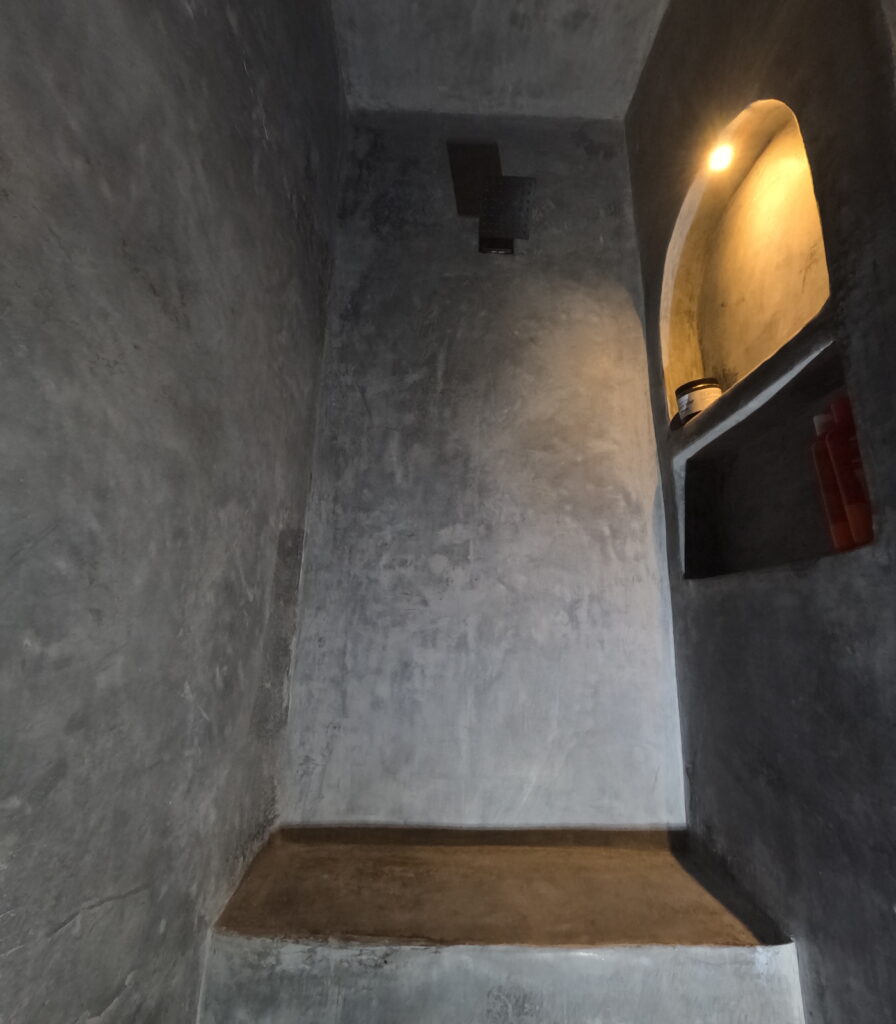
Tadelakt and microcement are continuous. Walls, niches and a bench can run as one surface, so the shower reads as carved rather than assembled. Tadelakt has a soft sheen and gentle variation in tone that changes with the light; microcement is flatter and more modern.
Living with it
Tadelakt
Tadelakt holds up well as long as you are happy for it to develop a patina. The main upkeep is not damaging it: avoid harsh or acidic cleaners and anything that scratches, and clean it with black olive-oil soap, which also keeps up the water resistance. It is not indestructible: a hard knock can chip it, but a skilled applicator can patch and re-polish an area so it reads as continuous, without the grout-joint scars of a replaced tile.
Tile
Porcelain and glazed tile shrug off most cleaners. The work is in the grout, which needs keeping clean and, depending on the grout, sealing, and in Charleston’s humidity grout lines are where mildew starts if a bathroom is not well ventilated. Natural stone needs more care than porcelain.
Microcement
Microcement is the lowest-maintenance of the three: seamless like tadelakt, with a sealed surface that is easy to wipe down.
Where each one suits, and where it doesn’t
Tadelakt suits walls, niches, benches and tub surrounds, and a house with old-world, Mediterranean or Spanish character. Shower floors can be done in tadelakt but take more upkeep, because feet wear the surface; microcement is often the better floor under tadelakt walls. It is a poor choice for anyone who wants a surface that never changes, because the patina is part of it.
Tile suits almost any house, and it is the right answer where the design calls for a pattern, a particular stone, or a traditional look such as marble in a period house. It is the least forgiving of a poor waterproofing install, because water that gets behind the grout goes unseen.
Microcement suits a modern or minimal bathroom, shower floors, and anyone who wants seamless walls with the least upkeep. In a traditional house it can look out of place.
The house matters as much as the room. In a Mediterranean or Spanish-style house, plaster walls are part of the architecture and modern tile looks out of place; in a Charleston single house with marble elsewhere, tile may be the finish that belongs.
What the decision comes down to
- The look you want: a grid with a pattern, a soft seamless plaster, or a sleek seamless surface.
- How much upkeep you’ll do: grout care, a black-soap routine, or a wipe-down.
- The house: which finish suits its style and age.
- Who installs it: tadelakt in particular depends on the applicator. Most tile installers cannot apply it.
Zach applies our tadelakt himself, and we bring samples to the consultation so you can see and feel the finish in your own light. Our tadelakt guide covers how it goes on and how to look after it, and our tadelakt and specialty plaster page covers microcement and the other finishes. For the rest of the room, see bathroom remodeling, or request a consultation.
Sources: Schluter Systems, KERDI waterproofing membrane; Johns Manville, GoBoard and its installation guide.
OTHER SERVICES
FREE CONSULTATION
Let’s talk about your project
Let’s discuss your renovation vision and create a plan built to last.
843-709-6140Request a consultationWhat happens next: Zach calls you back and sets up a visit to your house. We talk about how you want to use the space, the style of the house and the materials that suit it. You get a budget and a design with the scope, we work through the options together, and then you get a final proposal.